
Safety & toxicology
Ecotoxicology
India's largest ecotoxicology department — 26 species across water, soil and air
- species
- 26
- Listed methods
- 18
- Guidelines
- 16
- Organism groups
- 12
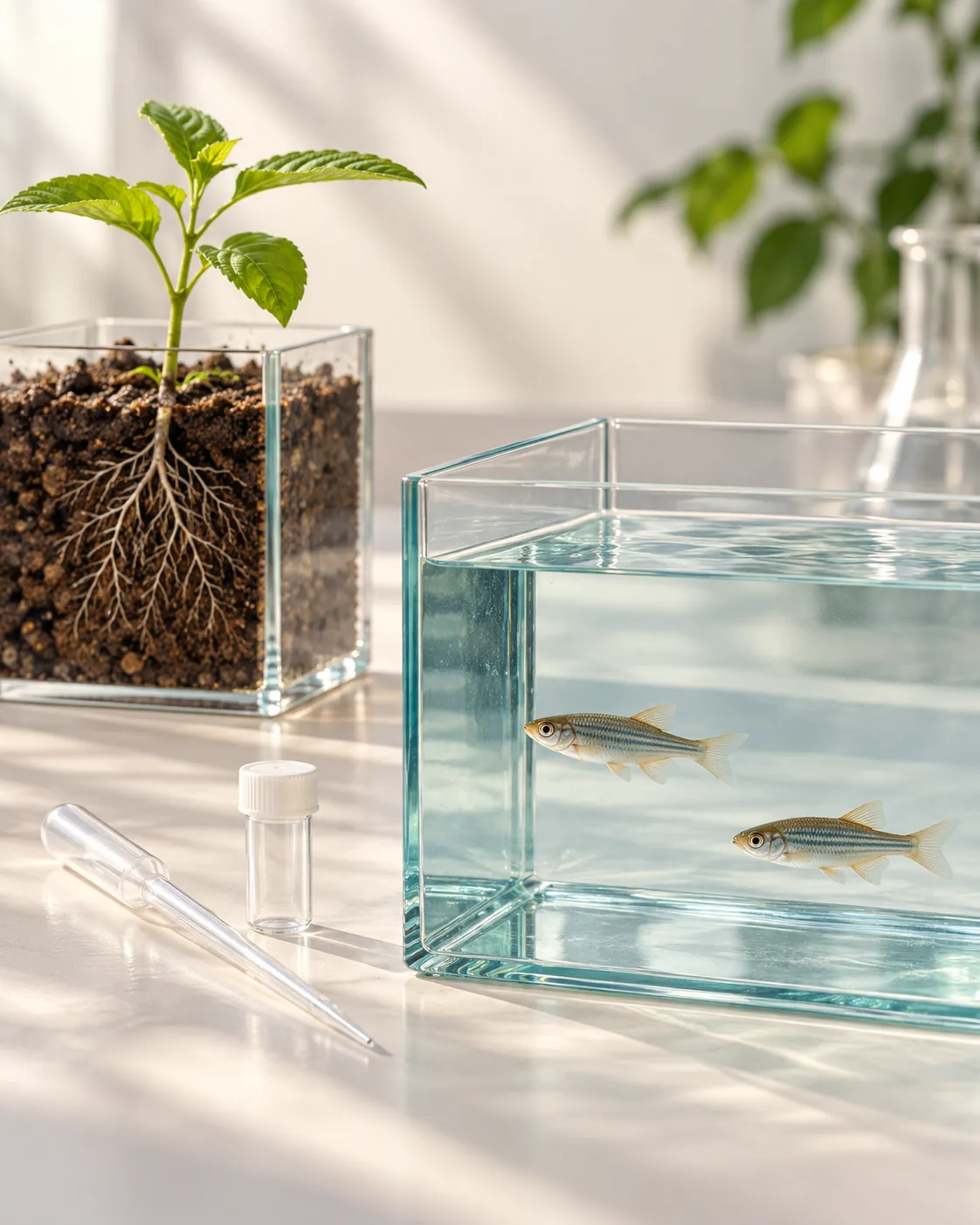
This is India's largest ecotoxicology department, and the breadth is the point: 26 species spanning birds, fish, algae, plants, honeybees, earthworms, crustaceans, molluscs, collembolans, ladybugs and lacewings. An environmental risk assessment is only as credible as the number of trophic levels behind it.
The division works to GLP and NABL standards, and its regulatory history includes registering India's first nano-fertiliser — a dossier with no domestic precedent to follow.
Aquatic, terrestrial and environmental-fate work runs in parallel rather than in sequence. Flow-through systems, plant growth chambers, cold rooms and micro-applicators let a single substance be characterised for acute aquatic toxicity, soil degradation and adsorption behaviour inside one programme.
Overview
Ecotoxicology, in overview.
Discipline group
Safety & toxicology
Capability groups
3
Capabilities
Three capability groups. 18 listed methods.
Every method below runs inside the same quality system, against the same archive, with the same chain of custody. Study designs are assembled from this catalogue rather than improvised around it.
Aquatic toxicity
6 methods
- Fish acute toxicity (OECD 203)
- Daphnia acute immobilisation (OECD 202)
- Daphnia reproduction (OECD 211)
- Algal growth inhibition (OECD 201)
- Bioaccumulation in fish (OECD 305)
- Marine and freshwater mollusc toxicity
Terrestrial toxicity
7 methods
- Earthworm acute toxicity (OECD 207)
- Earthworm reproduction (OECD 222)
- Honeybee toxicity (OECD 213)
- Terrestrial plant seedling growth (OECD 208)
- Vegetative vigour (OECD 227)
- OECD 218
- Avian oral toxicity
Environmental fate
5 methods
- Ready biodegradability (OECD 301)
- Biodegradation simulation (OECD 314)
- Aerobic and anaerobic soil transformation (OECD 307)
- Adsorption/desorption using a batch equilibrium method (OECD 106)
- Estimation of adsorption coefficient by HPLC (OECD 121)
Specifications
On the record.
Guideline numbers, test species and instrument names are reproduced exactly as the laboratory publishes them, because a method is only portable across borders if it can be named precisely.
Guidelines worked to
16 on file- OECD 106
- OECD 121
- OECD 201
- OECD 202
- OECD 203
- OECD 207
- OECD 208
- OECD 211
- OECD 213
- OECD 218
- OECD 222
- OECD 227
- OECD 301
- OECD 305
- OECD 307
- OECD 314
Organism groups
12 listed- Birds
- Fish
- Algae
- Higher plants
- Honeybees
- Earthworms
- Crustaceans
- Molluscs
- Collembolans
- Ladybugs
- Lacewings
- Mussels and snails
Instrument estate
4 platforms- 01Plant growth chambers
- 02Cold rooms
- 03Flow-through systems
- 04Micro-applicators
Under accreditation
What governs this work.
Ecotoxicology operates inside the quality system audited under the certifications listed here.
- OECD GLP
- NABL
Good Laboratory Practice certification
OECD GLPNGCMA, Department of Science and Technology, Government of India
Compliance with OECD Principles of Good Laboratory Practice, the basis on which study reports are accepted across all OECD Mutual Acceptance of Data countries.
View the certificateISO/IEC 17025:2017 accreditation
NABLNational Accreditation Board for Testing and Calibration Laboratories
Technical competence of the testing laboratory against the international standard for testing and calibration laboratories.
View the certificate
Runs alongside
Nothing here works alone.
Most programmes cross three or four divisions. On one campus, under one quality system, that crossing costs a corridor rather than a shipment.